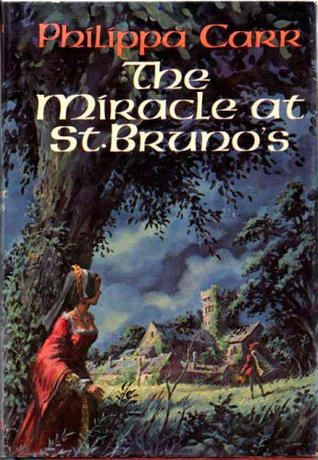
I have noticed a fairly disturbing trend present in a number of romance novels I have encountered through my life, and would like to speak about two books in particular, as their setting in early to mid 16th century Reformation England marks them as rough medievalism, and their publication dates in the 1970’s indicate to me a potential pattern in similar books of the publication era.
CW: The tropes of early romance novels often included difficult topics and I am going to discuss two in particular within this essay; namely, rape and incest.

Published in 1972 as the first novel under the new pen name Philippa Carr, The Miracle at St. Bruno’s is the first in Carr’s Daughters of England series, told through a series of first-person diaries written by the eldest daughter of each subsequent generation, from Henry VIII’s reign all the way through WWII.
Philippa Carr, actually the 7th and final pseudonym of prolific historical romance author Eleanor Hibbert (née Buford), published only titles in the Daughters of England series. Under the name Jean Plaidy, Hibbert published 91 total titles of historical fiction, including a reference bibliography at the back of each novel. As Victoria Holt she embraced Gothic romances, reviving and reinvigorating the genre. For the Carr novels, Hibbert used a more romantic writing style with first person narration and an emphasis more on the lived experience of moderately Noble women living in a historical past. There is a great deal of historicity embedded within the plot and narration, at times reading as so aggressively patriotic that I had to look up what was going on in England in the 60’s and 70’s to see if I was missing some subconscious influence (Feminism, rock’n’roll, Bloody Sunday, the list goes on).
There is some evidence Hibbert was aware her audiences would not necessarily move between her various pseudonyms, despite many of the similarities. Jean Plaidy’s works, for example, were also in nature historical romances. Unlike the Carr series, however, Plaidy’s novels were more historical in tone an occasionally used in British classrooms.
Regardless of which name and style Hibbert wrote under, her books up until the beginning of the Philippa Carr era were known for being clean and “PG” rated, choosing to eschew detailed physical encounters in favor of passages describing the smouldering looks shared between characters or the extreme longing they might feel. However, as shifts in societal perceptions surrounding sex and sexuality (sometimes called the 2nd sexual revolution) of the late 60’s and 70’s began to influence audience desires, the inclusion of more detailed physical relationships and even descriptive sex scenes became more commonplace. Hibbert’s novels published under the Victoria Holt name shifted with the times; Philippa Carr’s novels do not seem to.
And yet, the novels of the Daughters of England series disturb me in a different way, as I reread them for the first time since I transitioned. My relationship to gender and sexuality has always been counter to the social “norms,” but the additional study of queer theory through my MA process has continued to inform the way I analyze texts; I seem to no longer be able to quietly read potentially problematic work as I am increasingly aware of the negative impact interacting with repeated stereotypes can have on the identity of a person.
I did as much reading about Eleanor Hibbert as I could in preparation for this writing. In part because I knew there WAS a large amount of historicity inside her novels, and I wanted to know how intentional that research was. But I also wanted to see if I could find anyone still talking about her work. She published over 200 novels before her death in 1993, had been translated into at least 20 languages, sold over 100 million copies of her books, and received a Lifetime Achievement Award from the Romance Writers of America.
Yet today, 29 years after her death, the work of Philippa Carr is out of print and difficult to come by. Even her more popular works under the Plaidy or Holt names have become increasingly difficult to find, though a small number of Plaidy’s bibliography can be found through Three Rivers Press. Information, including historical interviews with Hibbert that mention her Carr work, has become nearly impossible to track down.
Terrible Tropes
Miracle at St. Bruno’s is told from the first person perspective of Damask Farland, the daughter of a Catholic lawyer in Henry VIII’s England. Next door is the formerly impressive St. Bruno’s abbey, where a child has been found in mysterious circumstances the year before Damask’s own birth. This child is named Bruno for the patron saint of the abbey; Damask’s orphaned distant cousins, Kate and Rupert, who are 2 and 4 years older, respectively, also come to live with the household.
As the historical Henry VIII moved through wives in the mid 16th century, the historical era known as The Reformation began. During this time the religion of England underwent a profound shift, moving between the accepted Catholicism headed by the Pope in Rome, and the newly established Church of England, of which Henry VIII was the Supreme Head. This granted Henry the ability to divorce his first wife, Katherine of Aragon, in favor of Anne Boleyn. For the people of England, the years of the Reformation were fraught with religious worry. Practicing the wrong version of Christianity could end with the loss of title, wealth, lands, and your life.
Damask Farland, the daughter of a Catholic man who once thought to join a monastery, witnesses the division between King Henry VIII and the Catholic Church first hand, through the dissolution of St. Bruno’s abbey on the order of the King. In reality, there were a number of sociopolitical events that led to Henry VIII’s dissolution of Catholic monasteries, but Damask, a girl of 12 in 1534 when Henry declared himself the Supreme Head of the Church of England, would not have had access to the kind of political and religious gossip that might have forewarned her what was coming.
Instead, Damask’s idyllic childhood comes to an end when the abbey comes under investigation. As part of Henry VIII’s new required tax rate of 10% on all Church lands, a number of commissioners were appointed to assess and catalog the wealth and holdings of all Church lands in England. The compiled document, called the Valor Ecclesiasticus (Church valuation) has survived to modernity, and is held by the National Archives in Kew, UK.
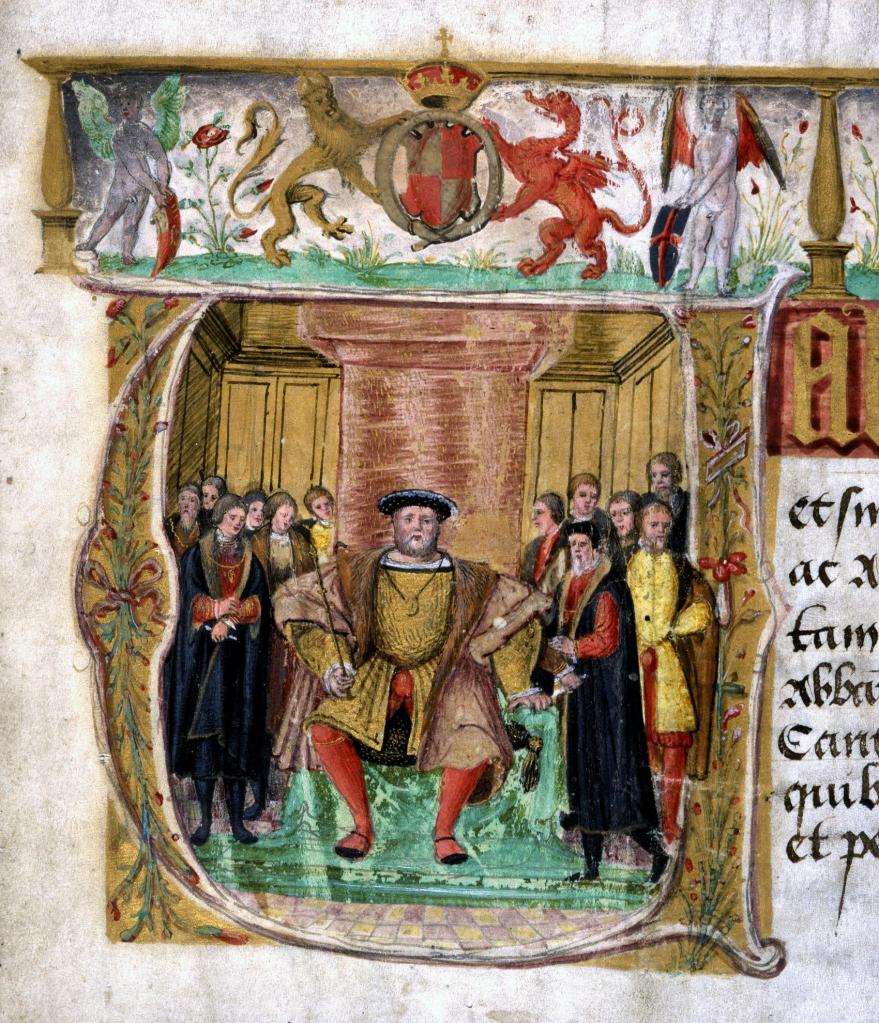
For Damask, the presence of a commissioner at St. Bruno’s Abbey signals the end of an era, as the secrets of the Abbey’s past are revealed, culminating with its disillusion. The mysterious child found in the abbey and raised there? The son of a monk and a serving girl, Damask’s own maid. Bruno had been raised to believe himself some sort of miracle, however, and finding himself homeless and penniless causes difficulty. Damask’s father takes him in, however, as well as 2 former monks from the abbey.
Here is where I struggle. While The Miracle at St. Bruno’s is the first in a series, it is meant to be in the romance genre, regardless. Damask’s feelings for Bruno are framed as interest, fascination, and the thrill of the unknown more than anything. They do eventually marry, and move onto the Abbey lands, which he has earned from Henry in service to the crown. He is secretive and strange with Damask, though, having told her during his proposal that they would be penniless should she accept, but if they loved each other they could survive it. She accepts him, of course, to find out that Bruno is actually fabulously wealthy, though he won’t say how.
Bruno rejects the story of his birth, insisting the confessions gotten from torture from his mother and father were untrue and coerced, Damask doesn’t seem to care if he’s a miracle or not, but she’s beginning to recognize the streak of cruelty that runs through her husband.
Kate, who has long been a sister and lives with her wealthy elderly husband in London, has two sons of her own, of an age with Damask’s daughter Catherine. Damask is also raising a young girl named Honey, who is the daughter of the same maid who birthed Bruno, and the man who acted as Henry’s commissioner at the abbey. It is when Catherine confesses her desire to marry Kate’s eldest son Carey that a full betrayal comes to light-Kate’s children are not her husband’s, but Bruno’s, making Catherine and Carey half-siblings. They obviously do not wed, but Bruno has a moment of cruelty where he tells Damask that she cannot tell Catherine the truth, simply that she is not to wed Carey. Even after Damask protests, saying Catherine is too head strong and would be likely to elope, Bruno essentially says “oh well,” because the alternative would be to admit he is not a miracle child, but a man subject to man’s folly.
I wish I could say that was the end of the incest-as-trope subject in the series, but it’s really not. The second book, The Lion Triumphant, released in 1973, follows Catherine as she attempts to heal from her heartbreak. Honey, who has been raised as Catherine’s sort-of sister, has married well and Catherine spends some time at Honey’s estates in Devon.
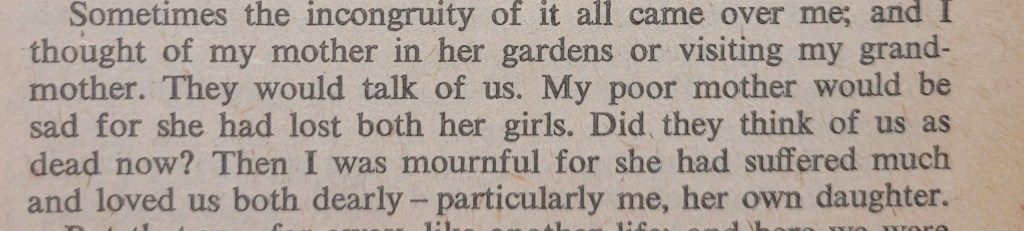
Catherine’s novel is a study in rape apology, feminine sexuality, and I would even posit BDSM, but I’ll expand on that in a separate post. What matters is Honey, and her second marriage. Honey, it turns out, has also always loved Carey, and she marries him near the end of The Lion Triumphant. However, in the second novel, there is never a mention of Honey’s parentage, or reference to her own relationship to Carey; she would be his half-aunt.
I’m wary of the internet, in terms of figuring out what on Earth was going on here. What search terms could I possibly use that wouldn’t return a result I don’t want to read about? I started with marriage in Tudor England, and found some interesting facts:
- Consanguinity referred to the blood connection between people, while affinity would be the legal relationship
- King Henry VIII’s grounds for divorcing his first wife Catherine of Aragon circle the concept of consanguinity-Katherine had first married Henry’s brother. If that marriage had been consummated, the relationship between Henry and Catherine would have been considered consanguineous, and therefore ineligible to marry each other. The Pope at the time refused to grant divorce to the pair; Henry asserted the Pope could not dissolve consanguineous relationships, but that he, as the Supreme Head of the Church of England, could.
- Royals and other nobles could request a dispensation from the Pope to marry a relative that had otherwise been considered too closely related
- The Marriage Act of 1540 allowed for cousins closer than 4th degree to wed, up to and including the marriage of 1st degree cousins (though the counting of degree varies slightly and isn’t the same terminology in practice today)
- There is one story about Richard III, whose reign was much maligned during the Tudor period, potentially wanting to marry his niece, though there is no hard evidence to this effect. It would have been possible, had both parties consented, and the Pope issued a dissolution.
So, what does that have to say about Carr’s novels? I’m not sure, but I’ll return to this as I continue working through the series and other romance novels written in the 1970’s, there’s a connection I’m beginning to see between the use of tropes and a political agenda to either support or undermine a monarch, and I’m curious what you think?
 Queerly Beloved
Leave a comment