Today I use the word queer to describe myself, because it can function like a catch-all word. I am queer in terms of sexuality, because I am not the “social default” expectation of straight, I am queer in my gender because what was assigned to me at birth is not correct, and I am queer in my relationship structures because I eschew traditional models of dating and relationships. So, rather than say I’m bi/pan AND transgender AND…I just say queer to indicate I interact with society in some sort of counter-cultural way.
Not all people in the LGBTQIA+ community are comfortable with the word queer, which is why you shouldn’t use it unless you’re sure it’s applicable for someone. In recent generations, the word was used entirely negatively, as a harmful slur first towards gay men, but also towards many in the LGBTQIA+ community that do not otherwise fit into the socially constructed definitions of gender and sexuality.
As an adjective, queer has been in use since the 1500’s as a way to denote something strange, unusual, or peculiar. Someone or something could be “queer” because they eschewed some type of social norm, and have nothing to do with their perceived sexuality. Through modernity, the association between what was “queer” as the non-normative linked itself to queer as an identity-the more visible the LGBTQIA+ became, the more the words were linked together.
Of course, understanding the contexts and history of the word’s usage does not undo the damage using queer as a slur can and has done to members of the community. As an academic, Queer Theory refers to the study of behavior, emotions, sexuality, etc., that are being portrayed as or are somehow linked to the social constructs of gender/sexual orientation etc. Queer becomes a broad term, meant to be as inclusive as possible and which seeks to challenge or deconstruct traditional ideas of sexuality and gender, especially the acceptance of heterosexuality as normative and the perception of a rigid dichotomy of male and female traits, according to the Oxford English Dictionary.
Medieval Queerness
The study of queerness in medieval literature, therefore, is not solely preoccupied with determining the sexual orientation of a given character or author. There seems to be this prevailing idea that to work with Queer Theory means to apply modern understandings of social norms onto the past, rather than understanding the past as a building block to the future we now find ourselves in. I have heard, from scholars as well as casual fans, trans and queer identities could NOT have existed in the middle ages, partially because the words we use hadn’t been invented yet (homosexual is a 19th century word, by the way), and partially because of the supposedly rigidly enforced rules of the time.
There’s so much to unpack there that I don’t even really want to touch it, but suffice it to say that just because there hasn’t been a word or phrase in use, doesn’t mean people didn’t exist. The work of queer theorists studying the past necessarily involves contextualizing ourselves in that past. I did a lot of this study over the course of my MA program, as my dissertation examined masculine behavior in Thomas Malory’s 15th century work Le Morte d’Arthur (The Death of Arthur), which is essentially the greatest piece of fan fiction ever written, in my opinion. In this version, Lancelot spends a LOT of time kissing other knights, expressing his deep and abiding love for Arthur and Gareth, and being referenced as a man of deep regard for the men he is closest to. Let’s take a closer look.
Le Morte d’Arthur
Thomas Malory did not invent King Arthur, who had been present in the written literary tradition for over half a century at that time, but instead compiled, translated, adapted, and expanded upon the vast Arthurian tradition to create a singular cohesive story. Many of the elements found within are recognizable to the modern audience, in part due to the anachronistic approach to historical fact Malory uses, and in part because of the enduring legacy of Malory’s work. Le Morte was immensely popular after publication, and has remained so in the intervening years.
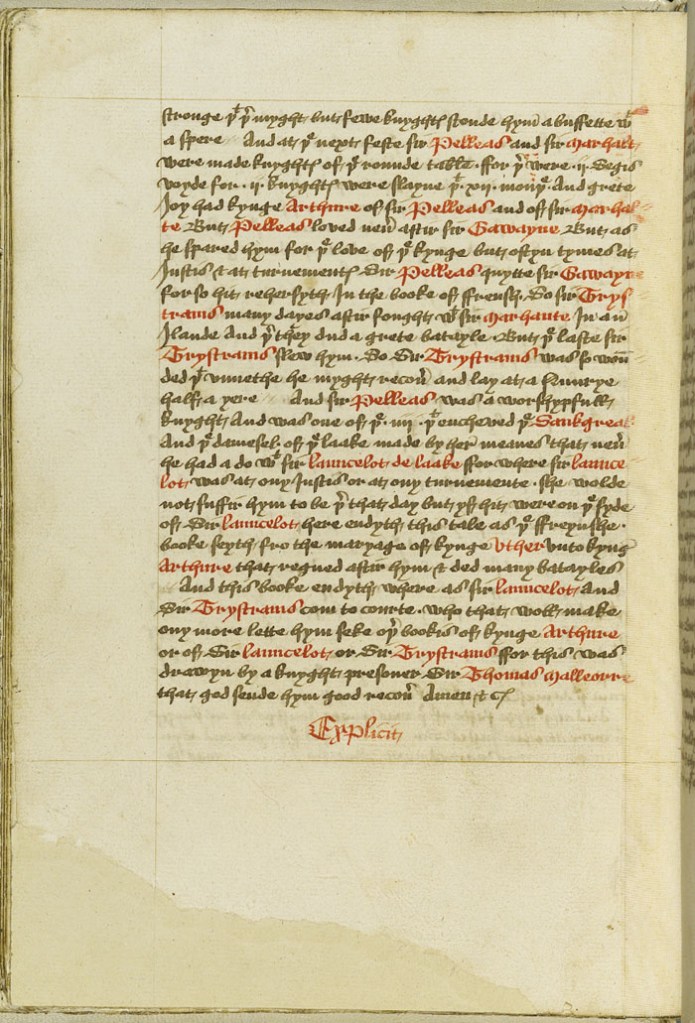
Launcelot du Lake is famous for his love affair with Guenevere, the wife of King Arthur. Royal in his own right, he has been raised by the Fairy Lady of the Lake after his father King Ban’s death and is unaware the kingdom he has the right to claim until much later in his life. He is the best of knights and the best of men, often depicted as the shining example of chivalrous behavior and knightly activity, if you ignore the adultery. However, I do assert that Malory’s Launcelot is queer, not because he is gay or homosexual, though I would argue that a modern term like bi/pan could be used for him, but because of his consistent breaks away from the proper etiquette of the time.
Quotes Out of Context
The following quotes out of context are largely from: Sir Thomas Malory, Le Morte d’Arthur: The Definitive Original Text, ed. P.J.C. Field (Cambridge, England: D.S. Brewer, 2017). Exceptions to source will be noted, and any Middle English words that may not translate easily are glossed.
- Tristram speaking of Launcelot: ‘[He is] pereles of curtesy and of knyghthode […] I wyll nat with my good wylle feyght no more with you, for the grete love I have to Sir Launcelot.’
- Launcelot cursing Tristram: ‘fye* upon hym, untrew knight to his lady! […] of all knyghtes in the worlde I have loved hym most and had most joye of hym, and all was for his noble dedys. And lette hym wete that the love between hym and me is done for ever, and that I gyff hym warnyng: from this day for the I woll be his mortall enemy.’
- *an exclamation of disgust
- King Arthur at Gawain’s deathbed: ‘And now ys my joy gone! For now, my nevew, Sir Gawayne, I woll discover me unto you, that in youre person and in Sir Launcelot I moste had my joy and myne affyaunce*. And now have I loste my joy of you bothe, wherefore all myne erthely joy ys gone fro me!’
- *assurance/confidence/trust/faithfulness
- ‘the joy that La Beale Isode made of Sir Trystrames there might no tunge telle, for of all men erthely she love hym moste.’
- Tristram regarding Launcelot: ‘That me repentyth,” seyde Sir Trystrames, “for of all knyghtes I loved moste to be in his felyshyp.” Than Sir Trystrames was ashamed and made grete mone* that ever any knyghtes sholde defame hym for the sake of his lady.’
- *moan/dramatic utterance
- ‘Then, said he, my name is Sir Lamorak de Galis. And my name is Sir Launcelot du Lake. Then they put up their swords, and kissed heartily together, and either made great joy of other.’*
- *From the online digitized version through Project Gutenburg
- ‘And then they both forthwithal went to the stone, and set them down upon it, and took off their helms to cool them, and either kissed other an hundred times.’
- Project Gutenburg Online
Synthesizing Meaning/Finding Context
It is clear the men of Malory’s Round Table express great depths of emotion and love regarding each other. To a modern audience with no context surrounding the middle ages and knighthood, their expressions of love and passion may feel inherently queer in nature, simply because modern men have significant cultural differences regarding acceptable displays of emotion and declarations of love.
Kissing was likewise a large part of daily life. The kiss of greeting was expected between those of similar Noble rank, and would often involve lips. When greeting a personage from a higher social class, the kiss would be cheek, hand, etc. Expressions of love seem to make no distinction between romantic and platonic, as modern people often attempt to do, and a small amount of words seem to be used in multiple ways. For example, the above quotes include passages “making joy of each other” both in terms of the known sexual, as in quote 4 wherein Isode and Tristram are known to have consummated their physical relationship. And yet, quotes 2, 5, and 6 involve men making the same great joy with each other. Tristram and Isode (Tristan/Isolde) mirror Launcelot and Guenevere, but the relationship Tristram has with Launcelot is likewise a space for scrutiny.
Launcelot has close and personal relationships with a handful of specific knights, expressed even by third parties as above and beyond the “normal” level-Gareth, Tristram, and Lamorak. Quote 7 shows the kiss of greeting between him and Tristram, yet specifies that they kiss “a hundred” times. Launcelot and Tristram are both foils for each other as representatives of chivalric knighthood and adulterous courtly love, but they also experience a depth of emotion between them that is not found between Tristram and any other character, even Isode.
Implied Sexuality
The other thing I love about so much of the medieval literature-the lack of detail in some regards while there is an abundance in others. In Le Morte descriptions of emotion and knightly behavior are elaborate and frequent, inter-personal relationships of other sorts, however, come with limited detail. There is much speculation regarding the physical nature of the Launcelot-Guenevere relationship, for example. There is not a textual mention of a physical affair taking place until much later in the text, when Gawain’s brothers have set a trap to prove to Arthur about the affair: ‘And whether they were abed or at other manner of disports, me list not hereof make no mention, for love that time was not as is now-a-days.’
So, really, is his relationship with Guenevere sexual? Who knows, it’s implied, and more heavily implied here, but Launcelot has woken naked in bed with others before. Launcelot has also by this time fathered Galahad with Elaine of Astolat, who used magic to assume Guenevere’s form in order to conceive a child of prophecy, so we know he is capable of and has had sex with at least one woman. And yet, the way he speaks of his love for Guenevere, the physical descriptions of his kisses and sleeping habits, and the way his fellow knights speak of his male-male relationships are indistinguishable in terms of gender. If he speaks to and behaves with Guenevere and Tristram in exactly the same way, what’s the difference between the two?
Final Thoughts-Hot Takes Edition
I will certainly elaborate in another post, but I am of the deeply held opinion that Launcelot, specifically as depicted by Thomas Malory in the 15th century Le Morte d’Arthur, is queer. Not because he is homosexual, though I believe he is under the bisexual umbrella, but because he behaves in ways he shouldn’t. It’s noticeable how much he loves Gareth, Lamorek, and Tristram to the point where it’s commented on frequently. In queering Launcelot, a well established literary figure by Malory’s time, there is space for analysis and question-why is this Launcelot behaving differently?
 Queerly Beloved
Leave a comment