I said what I said.
My first Vampire experience came somewhere during my early high school days, I don’t recall exactly. Allow me to set the scene: Me, a teenager with significant anxiety and depression, undiagnosed body dysphoria, and a flare for the melodramatic. And then I picked up this book:

I fell in love immediately. Not with the charming and charismatic Lestat de Lioncourt, the protagonist of nearly all the subsequent novels in the Vampire Chronicles series, but with the brooding Louis de Pointe du Lac. the 1994 film adaptation of the same name, which I believe to be an excellent adaptation, cast a then relatively unknown Brad Pitt in the role of Louis, and he embodied the sad, lost character I had so fallen for in the novel. Also, be still, my queer heart, they were both so gorgeous.

There is an incredible amount of vampire lore that Anne Rice created as she continued writing in the Vampire Chronicles series-13 novels in the main series, 2 additional stand-alone tie ins, and 5 from a series that began as unrelated and ended as part and parcel the same chronology.
I’ll be the first to admit I have not kept up with reading the more recent books. The magic of the early novels, Interview, The Vampire Lestat, Queen of the Damned, felt lost to me as the series progressed. Lestat, to me, is far less interesting or compelling than Louis, though Louis is consistently painted as dull or boring, full of regret for his vampire lifestyle.
Louis struggles with regret from his conception as a Vampire. Lestat, seeking companionship, finds Louis alone, mourning the loss of his brother and final relative, living recklessly in an attempt to join his family in death. Through the course of this book, and the film, the romantic and/or physical relationship between Louis and Lestat is somewhat downplayed. However, in subsequent books, Lestat refers to Louis as a “lover,” and other characters recognize the role Louis plays as Lestat’s companion. The queer undertones become explicit as the series continues, none of the vampires in the series seem to be anything other than some form of bi/pan/omni, but in this first novel, the queer is in the understated connection Louis feels to Lestat.
Louis regrets becoming a vampire when he sees the cost of life necessary to support his own. He turns instead to drinking the blood of lesser animals, rats and chickens, and avoids humans. He evidences a disdain for Lestat, for forcing this life upon him, though with every negative thought he also mentions how attractive, compelling, or alluring he finds Lestat to be.
When Lestat feels Louis slipping away, he takes extreme measures. Louis experiences a lack of self-control for a brief moment, drinking the blood of a child (the novel says five, the movie makes her a more palatable ten) and leaving her for dead. Lestat has followed Louis, however, reveling in this example of proper vampiric behavior. He then turns Claudia, the child, into a vampire, never to age or grow up. He does this to evoke Louis’s paternal feelings, to keep Louis with him in order to care for the child and, as he says, to “bind” Louis to him more completely.
I’m not the first, nor will I be the last, to read queer identity into both Louis and Lestat. These are both men who, through the magic of immortal life, have no one but each other to understand why they are so different from everyone around them. Their urges and impulses (ostensibly to drink blood in order to survive) further alienate them, damn them, in Louis’s mind. He thinks his status as a vampire negates his soul ever going anywhere besides hell, if he ever dies at all. He punishes himself by drinking the blood of rats instead of humans, because he cannot trust his self control around human beings. He is queer because he lives a marginalized life he experiences a great amount of guilt for-despite the limited information available to him at the time of his turning.
AMC is filming a new adaptation of Interview with the Vampire, set to debut this fall. I’m thrilled with the casting choice for Louis-Jacob Anderson, lately of Game of Thrones notoriety where he played Grey Worm.
Only some images and teaser trailers have been released thus far, but I’m looking forward to it an incredible amount. I will, however, be incredibly disappointed with a lack of queer subtext, especially since the Louis/Lestat relationship is literary canon at this point, when it wasn’t in 1994.
While considering my thoughts surrounding Anne Rice’s work, these meme popped up on one of my feeds:
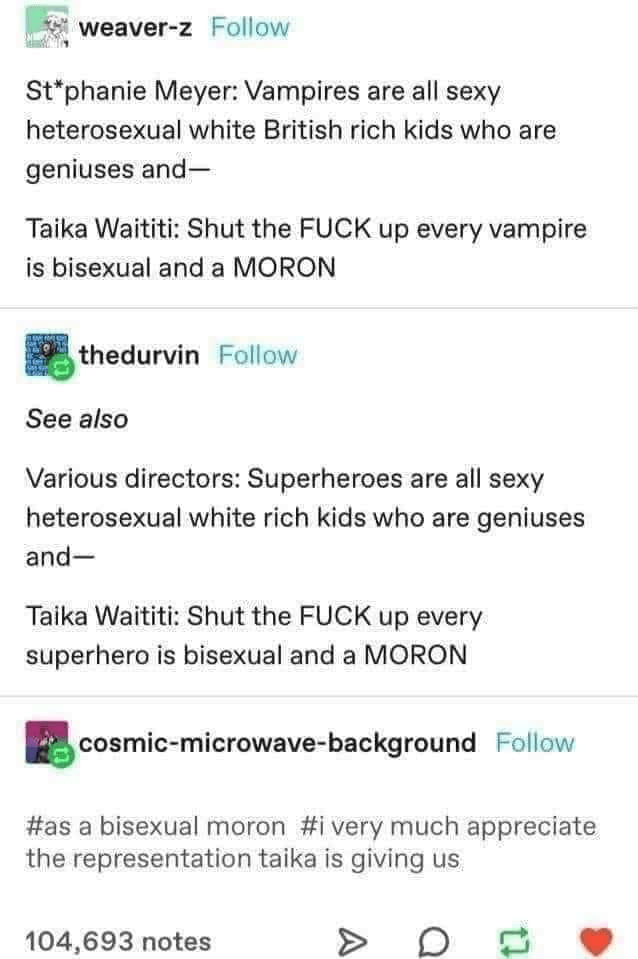
PERFECT. OK, let’s think about it. First of all, if we’re discussing modern vampires, we have to discuss Twilight, right? I don’t need to summarize here, but the main relationship is heterosexual, right? Well, plenty of internet fan fiction can attest to the underlying queer motifs present in Bella/Alice/Edward/etc., but I would suggest that Meyer’s approach to vampires is akin to academia’s approach to reading male relationships in historical literature-they straight wash it.
Vampires have always represented queerness. While I think we can argue about different examples representing different aspects of queerness, it remains consistent across European-derived vampire literature that the vampire is a social outcast. The vampire is odd and unsettling, with urges and desires contrary to acceptable social behavior. At the same time, they’re given powers of seduction and mind control-because how else would they attract a “proper” bride otherwise? Vampires therefore MUST be imbued with unearthly levels of perception and intelligence or else the protagonist, the proper human, would be able to outwit or withstand the vampire’s advances.
Taika Waititi seems to inherently understand this, as evidenced through What We Do in the Shadows (both the film and the show). Much like Waititi’s other currently running and super-queer show Our Flag Means Death, every character and moment in Shadows is suffused with the queer. Characters express their attractions, romances, and love relationships without any pause or indication that the queer might be unacceptable. Introductions to Nadja and Laszlo, my favorite characters, begin with a reference to a sexual relationship each had with the Baron, a male character. It’s a humorous moment because Nadja and Laszlo are married to each other, but answering interview questions on camera alone. When asked about the Baron, their answers are nearly identical to each other. The joke isn’t that they “cheated” on each other or that Laszlo is gay, the joke is they’ve been together so long and fit together so well that their tastes and their jokes reflect each other.
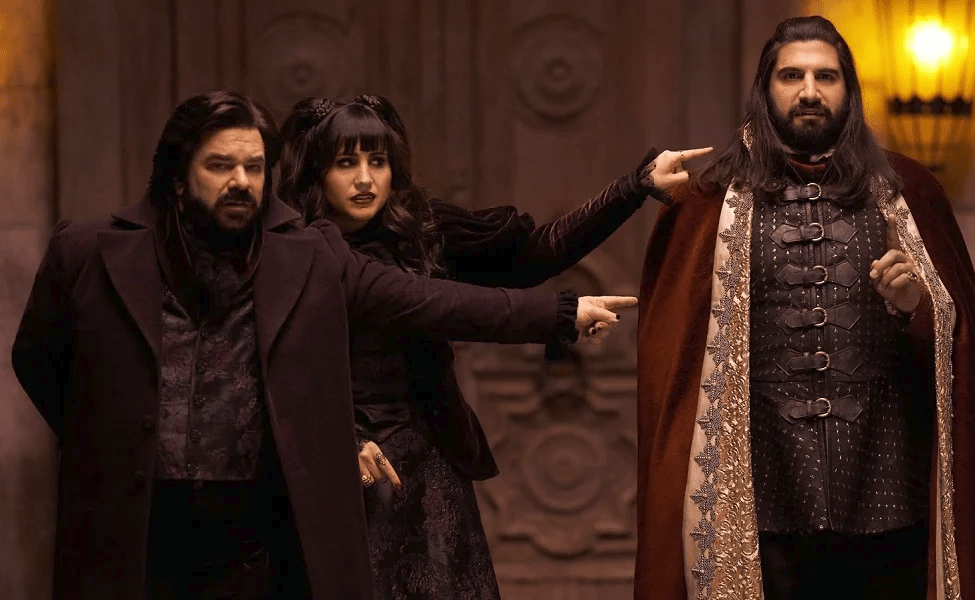
Every single character, except Guillermo, is a queer disaster. And ok, Guillermo is absolutely a queer disaster too, in that as the human servant to Nandor he is both alienated from the vampires, and from the humans that make up his master’s food source. Guillermo is either relentlessly in love with Nandor, or with the idea of being a vampire, and the course of the show’s 3 currently aired seasons show him grappling with this confusion.
Final Thoughts
Obviously I’ve barely begun to talk about modern vampires in popular culture, and it’s clear after the renewal news for WWDITS seasons 4, 5, AND 6, as well as the forthcoming Interview series, we aren’t lacking for vampire media. I just hope that we can continue to explore the balance between the queer history of vampires and the important work of inclusive and diverse character creation and representation on film. Taika Waititi seems to know how to walk that line marvelously.
 Queerly Beloved
Leave a comment