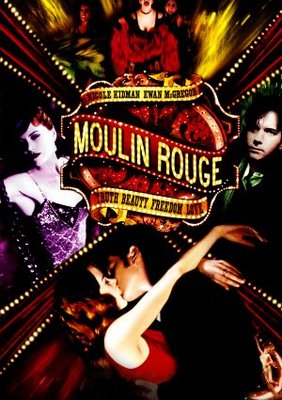
My favorite romance of all time isn’t even a novel, it’s a film. Written, directed, and produced by Baz Luhrmann, Moulin Rouge! (2001) remains my all time favorite romance, as well as favorite film, despite some uncomfortable moments. Hopefully a dive into Baz Luhrmann’s work, ahead of the June 24th theatrical release for his new project Elvis, won’t ruin the heavy nostalgia and fondness I feel for Moulin Rouge! It’s also proof that not all of my OTP’s are queer.
For the unfamiliar, Moulin Rouge! is a film told in hindsight. At the time of its theatrical release, Luhrmann had already received accolades for earlier films Strictly Ballroom and Romeo+Juliet, setting the stage for the type of anachronistic (historical, but not necessarily accurate for the time) story-telling to be expected. The opening credits of the film further inform audiences, before a line of dialogue is even spoken, what to expect. Let’s watch the opening credits scene:
The use of the conductor with the full orchestra illustrates the importance of the physical location of the stage. We know we are viewing a film, the 20th Century Fox Logo would not otherwise appear, but the use of curtain, conductor, and sound emulates the physical expectation of going to the theater. This is especially important to Lurhmann’s style because now the expectation is for a stage production. This means that props, costumes, locations, etc., might feel or look fake, rather than immersive, because a stage production is limited to the physical area. A film can play with camera angles, go outside, find new locations; but a stage can only use the stage and creativity.
Transported to 1900 Paris, Christian begins to narrate the film. He tells us the woman he loves is dead, but he said he’d tell their story. And so he begins-he came to Paris to seek his fortune as a young writer. He had heard of the Bohemian lifestyle which prioritized truth, beauty, freedom, and love above all else. Did I mention before now that Christian is played by a young Ewan McGregor? No? Well, he is. AND, because Moulin Rouge! is a musical, Ewan does his own singing, too. I was in love with Christian long before I was in love with Obi-Wan Kenobi.

Also, I just did the math on how old Ewan McGregor was in 2001, and he would have been 30 that year. Which means, he is older here than I am now, and I hadn’t realized that before. I’m having a moment here, and I’m not going to edit this out later because half of the early love and nostalgia was my gay panic for 30-year-old Ewan McGregor singing love songs. I thought he was so old. I would have been about 13 the first time I saw the movie (edited on television, with my mom). Now, as a 30-something living in the downfall of society, that apartment penniless writer Christian had looks much larger than what half my friends can afford in Chicago. Just saying.
ANYWAY
Christian immediately realizes he cannot write about the Bohemian ideals:
There was just one problem: I had never been in love. Luckily, right at that moment, an unconscious Argentinean fell through my roof.
Christian, Moulin Rouge! (2001)
The upstairs neighbors had been rehearsing a play called Spectacular Spectacular which they hoped to write and perform for the star courtesan of the local Moulin Rouge, Satine. If successful, Satine would then convince the owner and proprietor, Harold Zidler, to fund the performance. Zidler has his own plans in motion, however, involving a wealthy Duke whose interest he hopes to capture with Satine’s wiles. If the Duke becomes infatuated enough with Satine, Zidler believe he would finance the conversion of the Moulin Rouge from a gentleman’s club into a proper and respectable theater. What follows in a comedy of errors and mistaken identity, transposed on top of a dramatic tragedy.
Satine first meets Christian at the Moulin Rouge, but believes him to be the Duke. Christian, encouraged by his new Bohemian friends to pursue alone time with Satine, has no idea what is going on. She does learn the truth, and Christian’s enormous talent for writing and singing secures the use of the Duke’s money and the Moulin Rouge’s premises for the play. As the musical is written and rehearsed, drama enfolds between the Duke/Christian/Satine. Satine also has been coughing blood at regular and increasingly frequent intervals.
The Historical Toulouse
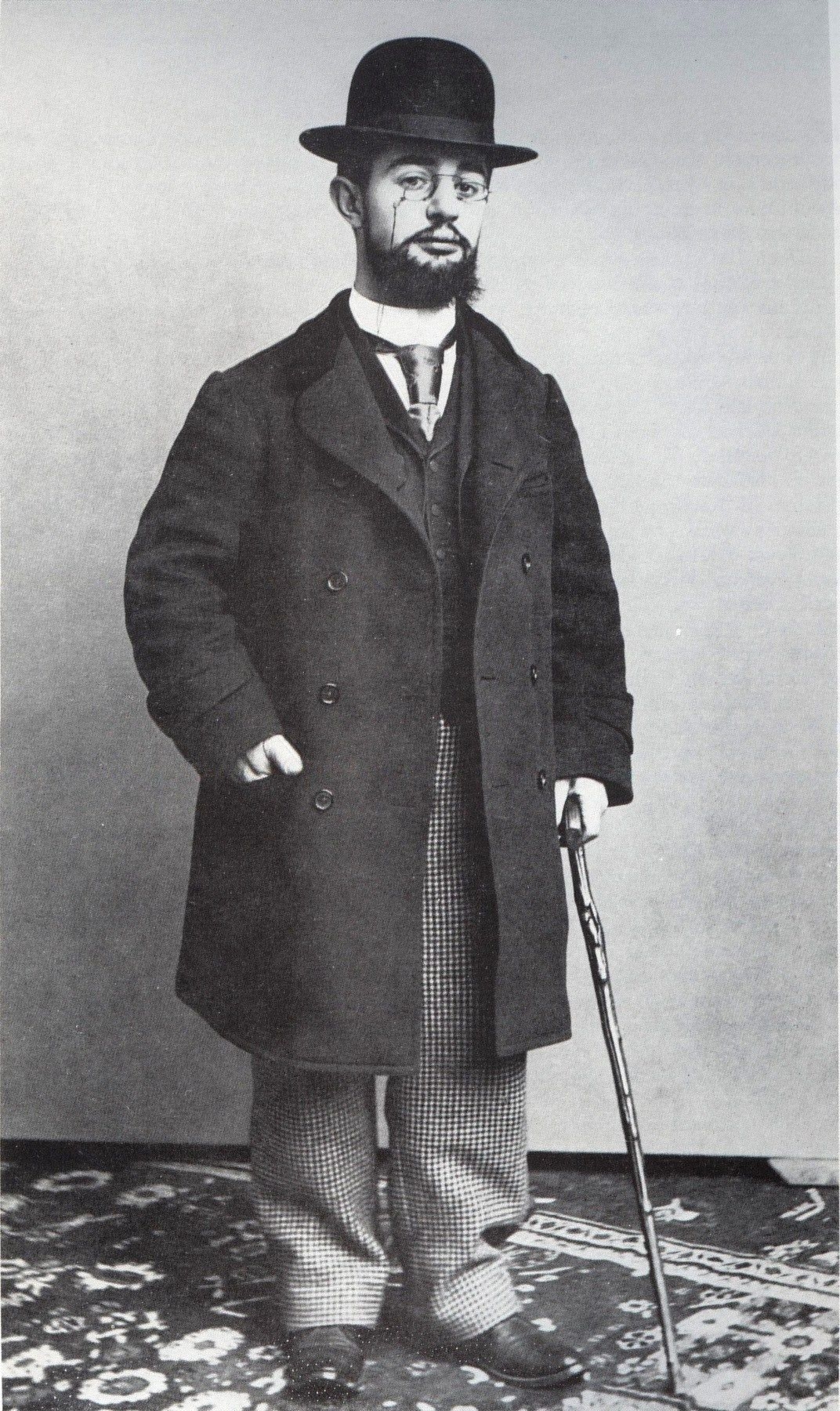
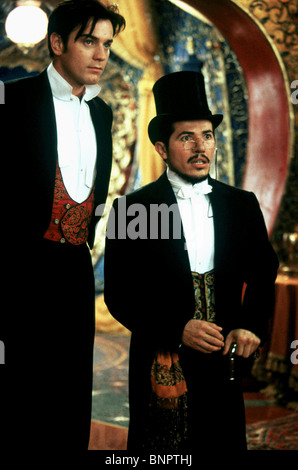
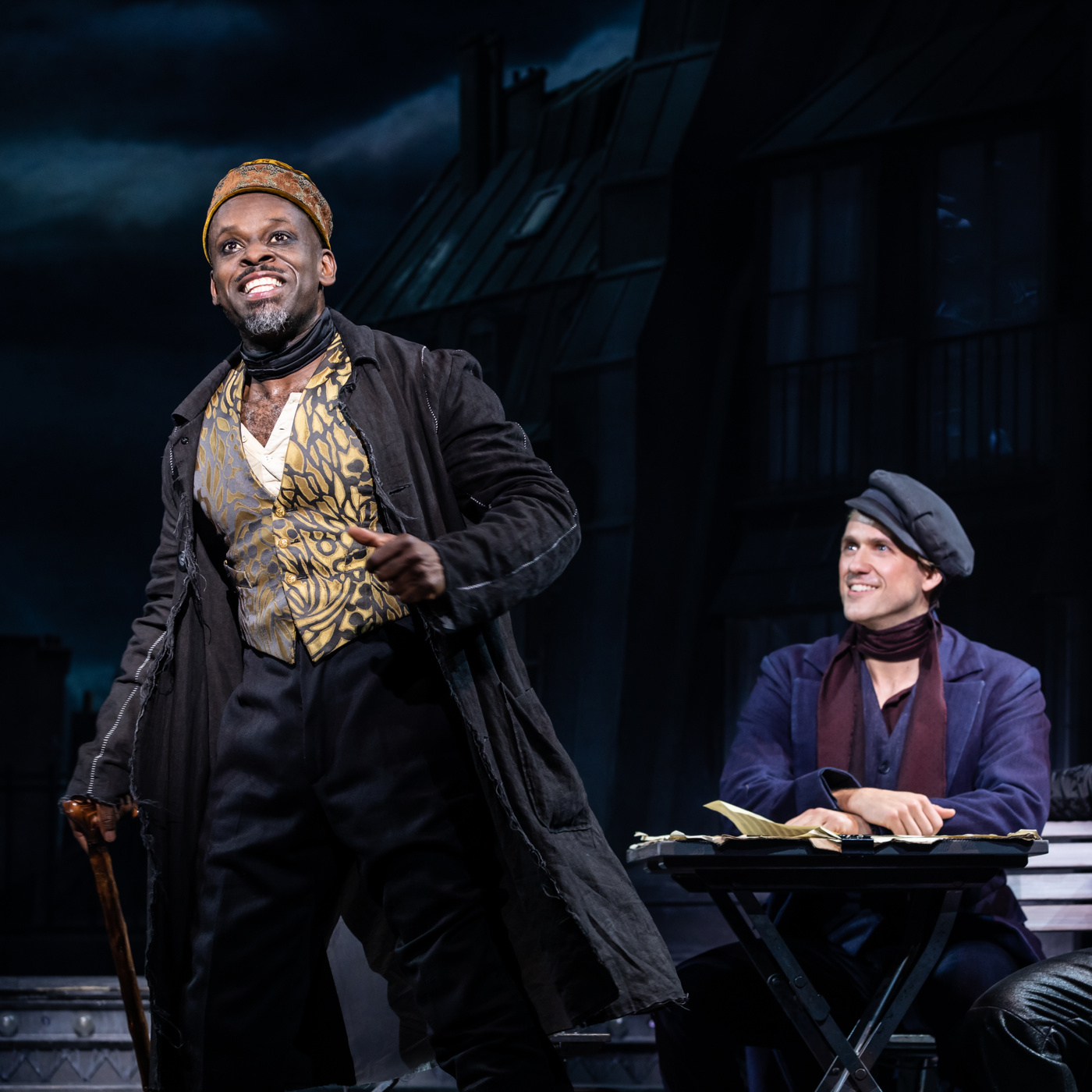
There is a lot of historical truth to Moulin Rouge! The Bohemian friend Christian makes at the start of the film is none other than Henri de Toulouse-Lautrec-Monfa, played by John Leguizama. The historical Toulouse was a painter and well-known to frequent brothels such as the Moulin Rouge. He was also disabled. He had broken his legs in his early teens, and they never healed properly. We are unsure if the frequency and severity of those breaks was due to an underlying condition. Leguizama affected the shortened stature of Toulouse by crouching or walking on his knees, with the lower parts of his legs being digitally removed. I like to think this would not be the case if the film was made today; in fact the Broadway production from 2019 gives performer Sahr Ngaujah a cane as a prop, which he uses to indicate a level of difficulty walking that does not feel as offensively ablest as the 2001 film. Pictured below left to right: A historical photo of the real Toulouse, Leguizamo in the role, and Ngaujah.
Jane Avril and the Moulin Rouge
The Moulin Rouge was also a real establishment patronized by Toulouse. He painted a number of pieces featuring the inside of the establishment, as well as of the principal dancer Jane Avril, upon whom Satine was loosely based. Toulouse painted multiple portraits of Avril, including this poster dated 1893:
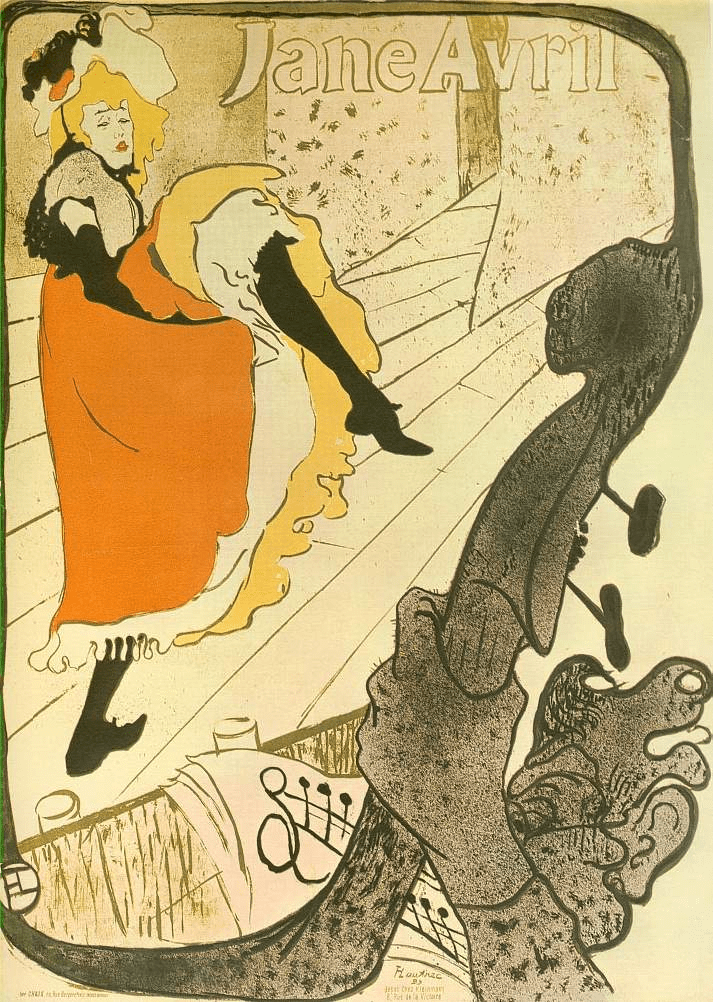
Avril is often credited as the creator of the French Can-Can dance, a dance which appears near the beginning of Moulin Rouge! When Toulouse and company take Christian to the club for the first time, he is greeted with an assault to his sense. Loud, musical, colorful, and filled with debauchery, Christian is overwhelmed. Luhrmann likewise continues with his anachronistic portrayal of the past-this scene is called “Diamond Dogs” after the David Bowie song, and also features moments from other popular songs of the time like Nirvana’s “Smells Like Teen Spirit,” and “Because We Can” which is credited to Fatboy Slim.
La Bohème
Finally, we come to early source material of a fictionalized nature. While Toulouse was a real man and member of the French Bohemian movement, Christian is a fictionalized writer seeking his fortune in France. Based on the 1851 novel Scènes de la vie de Bohème (Scenes of a Bohemian Life), the stage opera forms the inspiration for Christian’s character creation. Musical fans may recognize this opera, as it also forms the inspirational basis to the 1996 rock opera Rent.
Luhrmann gives defined edges to the Bohemian lifestyle when he has Christian narrate his entrance to the scene:
It was 1899, the summer of love. I knew nothing of the Moulin Rouge, Harold Zidler or Satine. The world had been swept up in a Bohemian revolution and I had traveled from London to be a part of it. On the hill near Paris was the village of Montmartre. It was not, as my father said, a village of sin, but the center of the Bohemian world. Musicians, painters, writers. They were known as the children of the Revolution. Yes. I had come to live a penniless existence. I had come to write about truth, beauty, freedom, and that which I believed in above all things: love.
Moulin Rouge! (2001)
The Bohemian movement of France began in the mid-19th century, but lacked specific definitions and borders. In essence, the Bohemian movement was associated with unconventional lifestyles, free love, frugality, adventure, wanderers, and anti-establishment sentiments. Creatives of all types flocked to Paris, writers like the fictional Christian, artists like the real Toulouse, to partake in this cultural revolution.
Finding the Queer
Typically, when I see mentions of “free love” and “unconventional lifestyles” I immediately think of the queer. LGBTQIA+ people are often grouped into the unconventional category through no fault of their own. Moulin Rouge! included only minor nods to this in the background of other scenes. Here is the opening to Christian’s first experience at the Moulin Rouge:
The majority of the dancers, and the focus of the camera, remains on the conventionally attractive female members of the chorus line. One woman can be seen wearing the traditional petticoats, but the top half of her dress emulates the formal suits worn by the patrons, top hat included, the imdb page lists this character’s stage name as “Travesty.” Other background moments include: heavily tattooed employees, men dressed in similarly bright clothing to the female dancers, and of course, Harold Zidler himself. The stage adaptation that premiered in 2019 addresses Zidler’s ambiguity by including references to ex boyfriends of the past. The stage musical also changes one of the primary dancers, Baby Doll, from a cis woman to a male Drag Queen. Drag style and makeup had already played a prominent role in the film, as a nod to the inherently queer and LGBTQIA+-centric source material; updating the character for the modern stage production felt like an appropriate way to modernize.
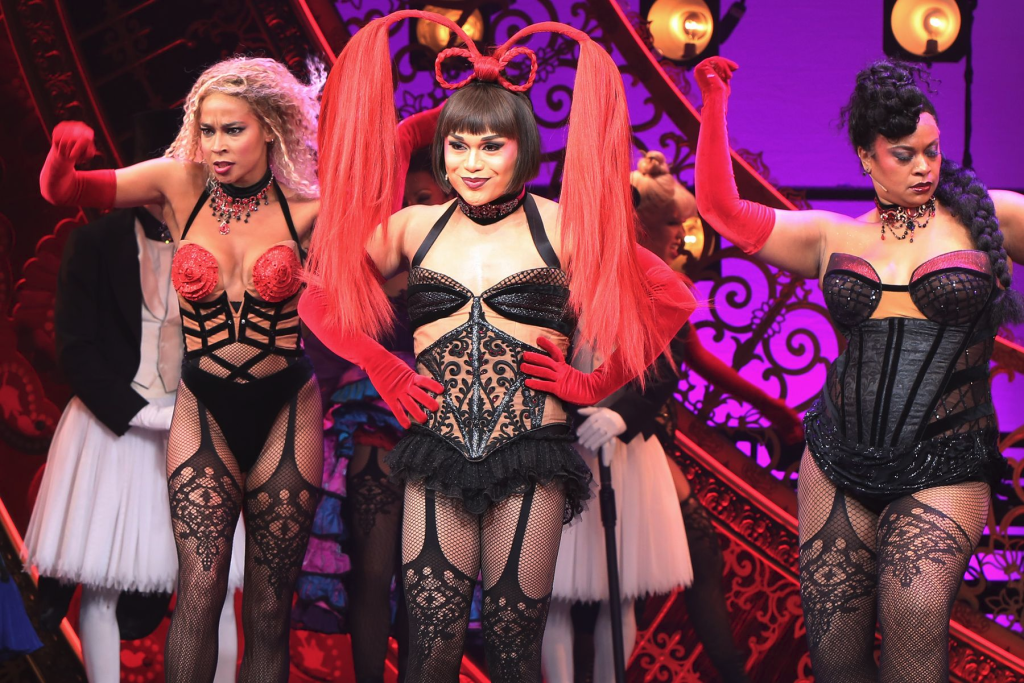
There is plenty of historical data to support a vibrant LGBTQIA+ community within the Bohemian Revolution of Paris. While Moulin Rouge! is a film about a male-female relationship, it still feels inherently queer to me. Illicit love, secret love, secret identities, these are all recognizable tropes of queer literature.
Returning to the 1996 production of Rent-here are the strongly queer moments. Modernized to New York City in the 1990’s, Rent follows a group of young and impoverished creative types rebelling against the social system. Instead of tuberculosis, the fatal disease present in 19th century France and the disease responsible for Satine’s untimely death, is re-imagined as part of the HIV crisis. Protagonists Roger and Mimi, both infected with HIV, parallel Christian and Satine, though Roger and Mimi have a less tragic ending. My favorite musical number, “La Vie Boheme” encapsulates the bohemian ethos with the lyrics “To anyone out of the mainstream” and “To anyone alive with a sex drive.”
Final Thoughts
Moulin Rouge! remains my all-time favorite romance. I think it’s clear I was picking up on the camp and underlying queer allegory all this time, and it makes a lot of sense to me in hindsight that I love it so much. I think the movie largely holds up, but the changes the 2019 stage adaptation made only increased the joy I found in watching.
 Queerly Beloved
Leave a comment