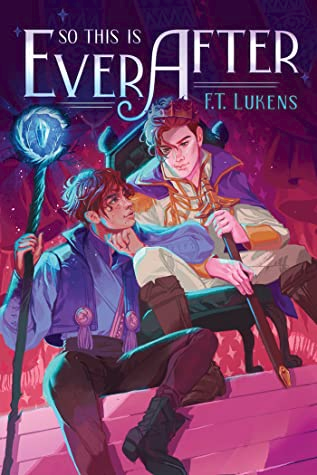
I’ll give you one guess why I saw this cover on an end cap at the library and immediately checked it out.
And yes, it’s absolutely exactly as queer as I was hoping for.
So This is Ever After begins at the end of a traditional fantasy novel-the chosen one has defeated the Big Bad™ according to prophecy….now what?
In Arek’s case, the “now what” is a whole bunch of magical chaos. Surrounded by his ragtag friends, Arek is pressured to immediately place the crown upon his own head, despite the crown’s current location atop the decapitated head of the aforementioned Big Bad™. Now, sure, he’d rather wash it first, or even find an entirely new crown to wear instead, but peer pressure is a bitch at 17, fantasy realm or not, so he puts the crown on anyway.
Of course that was a bad idea. Turns out, there’s some sort of magical binding in place between kingdom and crown-Arek is stuck now.
Monarchs of this kingdom, called Ere, must soul-bond to a spouse by their eighteenth birthday or fade away. Arek, for the record, turns 18 in three months. He has no significant other, but he DOES have raging hormones, a significant crush, and the aid of his best friend, the court Mage Matt. Enlisting Matt’s aid, Arek attempts to woo one of his companions, figuring a marriage based on friendship would be more palatable for his spouse than tying a stranger to him for the entirety of their lives.
Arek is delightfully oblivious. While his hesitation to speak his feelings out loud make so much sense, how mortifying would it be to confess and be rejected, he is clearly a kind and compassionate person. He’s less concerned with his own fate than he is worried about “trapping” someone into a lifetime with him, because he knows 3 months is not enough to truly get to know someone well enough to decide to wed.
The book is funny and quirky, playing with the expected “chosen one” hero tropes as a way to avoid laborious or overly detailed world building and exposition. Because the Land of Ere is a fantasy realm, and because we know Arek defeated the Big Bad™ according to a prophecy given by a wizard, we don’t really need to know the particulars of Ere. There’s magic, there’s people, there must be more to it, but Arek relegates his companions to their various duties, and it works for the reader. We don’t need to be bogged down in the details of statesmanship, that’s not what this is about. It also reinforces the age of these characters,
Lukens does the same character-building cheat with Arek’s companions. They all vaguely resemble their D&D classes, which conveniently fills in the missing gaps of personality, behavior, skills, and background. They are:
Bethany the Bard-Charming, well-spoken, possessing a magical harp that increases her vocal ability.
Sionna the Fighter-Good with weapons, always ready to fight, definitely a Top.
Lila the Rogue-Part Fae, sneaky, intense, probably too good with knives, can steal your clothes from off your back.
Matt the Sorcerer-Arek’s bff since childhood. Magic inherent in his being, Arek’s right hand.
Rion the Knight-a literal knight, follows the rule of order, chivalrous and proper.
And of course, Arek the Chosen One-“Did I mention I was seventeen and had been living in close quarters with five beautiful people the last nine months?”
The anachronistic way Lukens blends well known D&D stereotype with established fantasy novel tropes allows for each character to be delightfully queer. There’s never a moment where any of the characters have to speak up and clarify they aren’t straight, it’s just a world that seems to behave as though there’s no expectation for “default” sexuality, which is what I would like to see.
Currently we live in a society that assumes everyone is straight and cisgender, and if they aren’t, it’s that person’s job to educate and inform everyone, regardless of the inherent danger associated with coming out, for some people. There’s an expectation that cisgender, heterosexual, binary behaviors are the norm, and more insidiously, the required expectation to exist in society. We ask queer people how old they were when they knew, how old they were when they came out, how old they were when they were sure. But here’s the thing, especially with first love.
How many people, queer or otherwise, marry their first love? Not that many. First dating experiences are universally uncomfortable, that’s why the awkward dating of teenage couples is such an understood trope in media; many of us have experienced those years. Puppy love, crushes, infatuation, these are all ways to describe various levels of romantic or sexual interest in another person, that indicate either a short time frame or some sort of transitory nature. And yet, we don’t belittle straight people for their initial experiences understanding these new feelings, just queer people. The doubts and discomfort that naturally arise in inter-personal relationships, especially in romantic and/or sexual ones, are expected and understood in a heterosexual pairing. Express misgiving or doubt in a first queer experience, though? You better be ready to defend your queerness ad nauseum, and likely won’t end up discussing your relationship at all.
For F.T. Lukens to casually work queerness into the fabric of the story does not mean it felt forced or fake. It just felt like, statistically, in a group of six teens, why would we assume all six of them are straight? Or Gay? Or anything? What consistently matters to these characters is consent, kindness, and love. Arek struggles with the spouse requirement, not because he is not in love, but because he would never force another person to commit to him without reciprocating those feelings. He has compassion above all else, and he didn’t lose that in the journey to defeat the Big Bad.™
The other thing I very much appreciate is the lack of M&M candy shell characters. What I mean is, you know the trope. Characters that on the surface are not very likeable, or downright awful, but deep down under the crunchy candy shell there’s a core of smooth sweet chocolate…
I might just be hungry.
All of Arek’s companion’s are decent people. Even Lila, the Rogue stereotype, treats others with courtesy if not kindness, and remains with Arek after he takes the crown.
I absolutely recommend the novel for fantasy fans, especially if you’re needing a wholesome palate cleanser that will leave you feeling good at the end. I already requested from the library Lukens’s other novel, In Deeper Water, which looks to be a queer coming of age story with PIRATES, so, I’m all in there. In closing, one of my favorite King Arek quotes.
How was I feeling? Like spoiled meat. Like brackish water. Like I had worked very hard at shearing and chasing sheep all over the field, and had fallen down a rocky hill, then trudged home to sleep on the floor, and woke up with a sore body and without purpose
So This is Ever After, F.T. Lukens (2022)
 Queerly Beloved
Leave a comment