
*except Wong and America Chavez, they save the day
Superhero franchises are incredibly popular right now; from the juggernaut Marvel cinematic Universe, to the reprisal of Tom Cruise’s Navy hero Maverick in the Top Gun films, superheroes, action heroes, anti-heroes, etc., have captured the imagination.
There are a number of “types” of hero, according to literary conventions. These types include:
- The Classical Hero
- Humble upbringing, destined for greatness, strong innate abilities
- Nearly perfect, sometimes to a fault.
- King Arthur, Luke Skywalker
- The Reluctant Hero
- Ordinary people with ordinary abilities
- Does not want the burden of a quest, but is the only one for the job
- Frodo Baggins, Avatar Aang
- The Superhero
- Super powerful, magical, beyond “human”
- Superman, nearly every Marvel or DC character in the media
- The Tragic Hero
- Possessing a fatal flaw that will ultimately lead to their downfall
- Otherwise a perfect hero, but the sense of doom permeates all
- Many Shakespeare characters, Oedipus
- The Anti-Hero
- Not possessing the “typical” hero personality, perhaps a bit morally grey
- Often more relatable to audiences
- Deadpool, Han Solo, Jay Gatsby
There are other forms, and sub-categories, on and on forever, but I think these are the big ones from which all other types flow. I especially like the anti-hero.
In medieval literature, heroic figures were literary allegory and instruction. Characters like Beowulf, King Arthur, and Charlemagne, provided a social road map for expected Noble class behaviors. Literary heroes were superhuman in that they often possessed access to supernatural or magical talismans and abilities, though they would not be considered superheroes like their contemporary counterparts. Gawain, for example, increases in strength and martial ability during the sunlight hours, and decreasing back to “human” standards after the sun sets in many of his tales.
I Feel Like a Hero and You’re My Heroine
Mirriam-Webster defines heroine:
- a mythological or legendary woman often of divine descent having great strength or ability
- a woman admired and eumlated for her achievements and qualities
- the principal female character in a literary or dramatic work
- the central female figure in an event or period
Strong female characters are hard to come by, in terms of multi-dimensional representation. They are often reduced to secondary characters or stereotypical tropes. You may have noticed my examples above neglected to include any non-male characters. This is not to say there are not female characters worthy of the mantle, but there are certainly fewer of them. NOT because women are worse at being a hero, but because the long literary history of our culture derived from a systemically male-lead one.
A friend on social media pointed out the other day that many incredibly powerful women in media have subsequently gone through a villain arc, or ultimately end their arc with their death as a plot development point. She included photos of Scarlet Witch, Daenerys Targaryen, and Sylvanas Windrunner.
The Birth of The Scarlet Witch
My interest in the MCU ebbs and flows. A peak came from last year’s Disney+ show Wandavision. Consisting of a 9 episode season, Wandavision follows Wanda and Vision in their idyllic life, following the events of Avengers: End Game. Of course, all is not what it seems on the surface, and the revelations that slowly start leaking out lead to some horrifying implications. Wanda is a grieving woman, reeling from not only the death of her true love in End Game, but that she was the one to kill him. Add in her entire lifetime of trauma-from the bombing of her home that orphaned her and her brother, to the death of that brother, on and on-and it becomes clear that the events of Wandavision represent an unhinged mind suffering from intense PTSD, with no friends, support, family, or love, to speak of. Using the sitcom setting, show-runners were able to insert existing MCU characters into established tropes.
Wanda is powerful and terrifying in this series, but she doesn’t start as an antagonist. Her grief is nuanced and deep, including the loss of her husband, her brother, her life, and her sons. Her grief for Vision’s loss had turned her to create Westview, a shocking twist that comes mid way through the series. It’s Wanda’s magic that stole all the people that make up Westview, putting them into characterizations that fit the idyllic sitcom-perfect home life Wanda is seeking to claim. This blatant misuse of power could be forgivable. The show takes pains to represent all aspects of Wanda, including not only her PTSD and grief, but the clear way she struggles with other mental illnesses related to depression. It’s brilliant and it gives her such power. Her struggle with Agatha Harkness at the end, and the ensuing slip into the madness of the Darkhold, however? Reductive at best, misogynistic at worst. Let me illustrate:
The Darkhold. OK, so, when Agatha reveals to Wanda that she’s a bad witch, etc., etc, we learn about The Darkhold, the magical grimoire Agatha is using to amplify her powers. Agatha tells Wanda there is an entire chapter dedicated to “The Scarlet Witch,” an extremely powerful witch of chaos magic; Agatha also believes this person to be Wanda. Wanda, whose powers to date had come, so she believed, from the experiments she and her brother underwent as part of HYDRA, is shocked by this news. If she has latent natural chaos magic, it changes everything about who she is and how her powers operate. I believe it is this question of identity rather than loss than provokes Wanda into using the Darkhold.
Because she knows the risks. Agatha is very forthcoming about the negative impact using the Darkhold has had on her body, showing Wanda her blackened fingers.
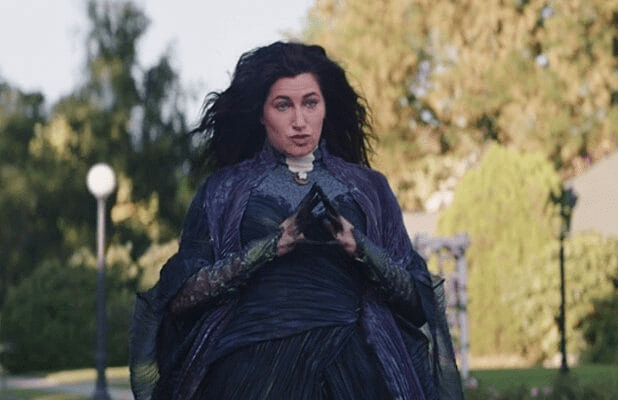
There is a moment when Agatha sees Wanda accept the mantle of Scarlet Witch and exclaims “what have I unleashed” which I believe is meant to be an indication for Wanda’s severity in Doctor Strange and the Multiverse of Madness. However, if chaos magic was the link to Scarlet Witch, and SW is supposed to be an antagonist, that’s pretty weak stuff. I mean, what does Wanda do immediately after this confrontation? She goes home, she tucks her children in to bed, and she removes the rest of her magic from Westview, freeing all the people she had trapped inside. Her children and Vision are part of Westview, part of her magic, and she knows it. But she had also been confronted with the truth, she was hurting the people involved in Westview, and she chose to release them peacefully before leaving. She doesn’t flee immediately, either, speaking to her almost-friend Monica Rambeau before leaving, indicating that she wants to study and understand her new powers. It is only after she begins to study the Darkhold in earnest, and in the SW uniform, that she hears an echo of her sons from a parallel dimension. This is where WandaVision leaves us.
Doctor Strange and the Multiverse of Madness
Without all that setup, I would have hated the newest Doctor Strange. Spoilers abound if you haven’t watched it yet.
Wanda is reduced, on film, to a grieving, unhinged, mother. She has been using The Darkhold for a period of time spanning at least a year, and has been off grid and out of contact from the other Avengers. When Doctor Strange needs to protect America from what feels like magic, he turns to Wanda for help and answers. Turns out, Wanda has gone very, very loopy since Steven saw her last.
A casual slip reveals Wanda is all too aware the identity of Strange’s current ward; Wanda has been watching the multiverse for a way to access her sons in a different reality-America’s inherent powers would allow Wanda to travel to them. It’s only one step over the line into truly crazy, really. If Wanda simply wanted to ask America for help, or to seek a universe where her sons have no mother, or something happened to her or something, that would have been more reasonable. But no, Wanda wants to murder this child to take her powers just in case she ever needs to travel again if her sons get sick or hurt in the future. The heavy implication is that Wanda has been corrupted by her heavy use of the Darkhold.
However, Doctor Strange or other characters mention at least twice in the course of the film that it just takes one use of The Darkhold to begin corruption, a fact that is corroborated by the death of Doctor Strange in a parallel universe our Steven and America end up in.
Wanda is a one trick pony the entire film. While I feel like her chaos magic should have made her more of a scary threat, the only real moment I felt fear was more because of how unsettling Wanda was being.
So, how does Doctor Strange save the day? WELL LET ME TELL YOU.
So. He does the very thing he’s not supposed to do which is like Steven Strange’s M.O., and uses the Darkhold to Dreamwalk. Except for some reason, he’s not corrupted. America forces Wanda into a parallel universe where her children are alive, and seeing her as Scarlet Witch causes them to recoil in terror. This is enough to break her focus from the fight. Her counterpart reassures her that her sons will have love from their mother, that it will be ok. This allows Wanda to apparently realize how far the Darkhold has corrupted her. America brings her back to the proper universe, where Wanda uses her ability to destroy the Darkhold’s fortress, wiping out the Darkhold in every universe, and apparently sacrificing herself in the process.
Steven Strange gets to live happily ever after with America and Wong, until the end credits reveal a third eye ripping itself into existence on his forehead, and the appearance of a mysterious woman informing him that he must fix the time incursion he has started. So, I suppose we will see him dealing with the fallout of using the Darkhold himself in the next Doctor Strange film, but it feels remarkably week.
We had this incredibly nuanced woman in WandaVision, and I know that over the course of 9 episodes and 10 hours you can flesh out a character much more than in just over 2+ hours, but I didn’t quite buy her descent into villainy. Especially when you consider the weight of her grief in the show, how she was shown to work through that grief, and how she still chose to do the right thing and release the people of Westview even though it meant giving up her children. Her intention in studying the Darkhold had nothing to do with her children and everything to do with self-discovery, as well.
And yet, she got too powerful. She got corrupted by the one thing Hollywood believes can corrupt woman, the pursuit of motherhood. Because of course this layered and dynamic character can want, love, and grieve the children she thought she had. Of course it’s ok for powerful women to want to be mothers, too. But none of her other development lead up to the belief that she would hurt so many other people simply to access a living version of those kids. I’d believe the corruption of The Darkhold could work that intensely, and maybe ignore that the MCU’s women seem to only have trauma around childbearing or the lack thereof (We ready to talk about that really weird Black Widow/Hulk moment yet?), IF STEVEN STRANGE DIDN’T USE IT SUCCESSFULLY. He’s such a generic sorcerer, not super likeable, not even all that memorable, but he’s the hero, I guess, so he gets to save the day by successfully doing the thing everyone told him not to do, because NO ONE can successfully do the thing. Except him, of course.
Final Thoughts
I dislike Doctor Strange.
 Queerly Beloved
Leave a comment