Not too long ago I wrote about HBO channel’s adaptation of The Time Traveler’s Wife, here. I had watched the first episode of the Steven Moffet led show, and immediately backed away in horror. To me, there was nothing romantic about the supposed romance between Clare and Henry. Clearly, lots of people agreed with me-HBO has declined to continue the show for a second season, despite Moffet’s intention to continue the story beyond the 6 current episodes.
But I did my spiel about it before. Today is about something new. Something that began airing July 9th, with Parts 2, 3, and 4 releasing in subsequent weeks on the Lifetime Movie Network.
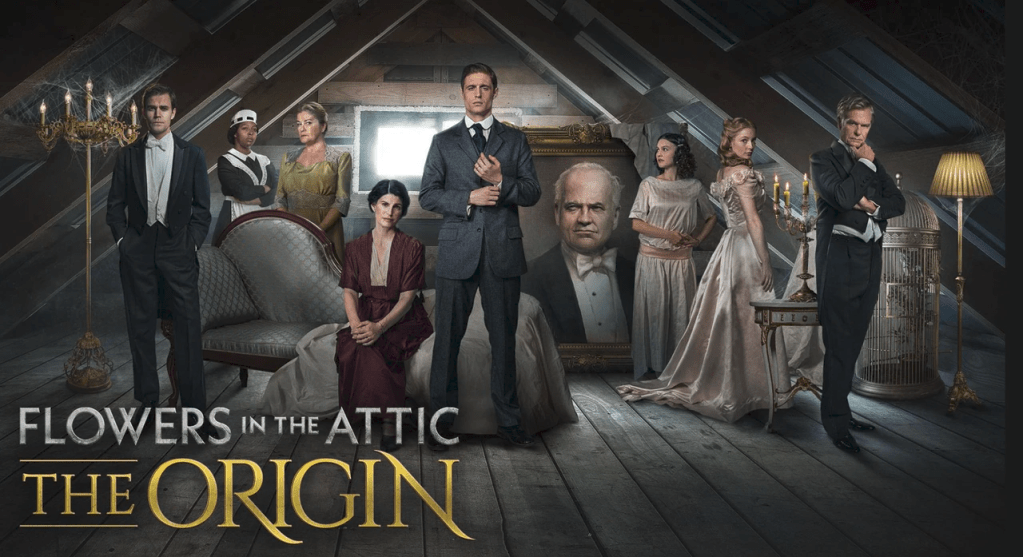
Yes, yet another adaptation of V.C. Andrews’s Flowers in the Attic world. If you can see from the promo photo, the cast is stacked, too. Kelsey Grammer, Kate Mulgrew, Paul Wesley, and Max Irons all make appearances, lending their star power to the endeavor.
What is Flowers in the Attic, you may be asking? Well, in 1979 a woman named V.C. Andrews published her first book about the Dollenganger family, and the rest, as they say, is history. Told in first person narration from the family’s second eldest child Cathy, Flowers in the Attic follows a family after disaster strikes and their father is killed. Their mother is flighty and irrational, unable to care for her remaining four children. She returns to her parents’ home, but there is a condition. Her father has written her out of the will because of her marriage to her husband, for reasons the children do not know. She has a plan to win back his favor, but she can’t tell him about her children in the meantime. She and her mother, an austere woman obsessed with proper behavior, devise a scheme to keep the four children locked in the attic in an unused wing of the mansion. Here they stay for over two years.
During this time the eldest children reach and pass puberty. The youngest two children, twins of 4 when they enter the attic, stop growing from lack of nutrition and sunlight. Cathy, an imaginative and clever young girl, develops hormonal and eventually romantic feelings for her elder brother. They consummate that relationship when he forces himself on her in a fit of hormonal rage, but Cathy thinks the whole time about how she would let him do it if he wants, it’s creepy. The series continues after the children escape the attic, sans one of the twins who has died from cyanide laced donuts their mother tried to feed them all. The sequel Petals on the Wind was released a year later and follows the three remaining Dollenganger’s as they try to build lives for themselves. They immediately are taken in by a housekeeper to a well off doctor who is much older than these children, but who also ends up sleeping with Cathy. This book is even more off the rails as Cathy has a plan to ruin her mother by seducing her mother’s new husband in secret and then having his child (which she does). She also gets married at one point and her husband is incredibly jealous of her relationship with her brother, wonder why. She marries the doctor after he has a stroke, and when he dies he encourages her to be with her brother because Chris has waited and loved her all these years. So they get married, change their last name, and move to California with her two kids. There are four total books in the series released before V.C. Andrews’s death in 1986, and they form a sort of circular plot wherein Cathy eventually is widowed just like her mother. However, in 1987 the estate hired ghost writer Andrew Neiderman to finish the manuscript of book 5, Garden of Shadows, which he did. This one is more a prequel, focusing on the grandmother before she came to Foxworth Hall.
Of the 100+ titles published under V.C. Andrews’s name, only eight of them were written by her in her lifetime. Of those 8, at least 2 were only started by her, but finished by Neiderman. I’m not sure what the connection is here entirely, but I believe the continued use of rape and incest motifs in all of these books have more to do with Neiderman than Andrews, but I am honestly unwilling to keep reading some of those titles to do some comparisons.
Flowers in the Attic: The Origin
Where I grew up, everyone had a Flowers in the Attic story. Because of the content including sex and incest, the books were ostensibly banned from our school. I don’t remember searching for them, but I remember sharing copies with a friend in high school whose grandmother owned the complete collection. We read the books together in secret, which was a common experience for young women in the years since the book’s publication. It wasn’t outlawed necessarily, but it was subversive, illicit, and exciting. So we read it, and the sequel, and a few others before losing interest/being too horrified to keep going/life happened and we moved on from it.
Yet as a culture we keep returning to the world. Adapted to film multiple times, Flowers in the Attic has been reprinted time an again. Neiderman keeps writing books in the series, as well. Along with the 2014 release of Lifetime Movie Network’s adaptation, Neiderman published two tie-in novels: Christopher’s Diary: Secrets of Foxworth in 2014 and Christopher’s Diary: Echoes of Dollenganger in 2015. The novels are repeats of early Flowers in the Attic moments, but seen through the eldest child’s eyes this time. And now this most recent adaptation.
It’s a prequel, as I mentioned earlier, following the austere grandmother as she marries in to the wealthy Foxworth family. We know by the end of the first couple books in the series there’s more than just the Cathy/Chris incest at play in this family. The grandmother has some secrets of her own, and I can see fans of the series wanting to know the back story to her life. She doesn’t have much of a character in the early novels, she’s a fixture of fear for the children that harps on proper behavior and innocent thoughts, obsessed with propriety. Well, it turns out part of why their mother had been disowned by the family was because her late husband was a biological relation. They didn’t grow up together, but she married a man who was, biologically, her father’s much younger half brother. This is part of why the grandmother, named Olivia, already hates the children, she believes they were born of sin and can therefore be nothing but sinful.
For once it appears the limited series is using preexisting source material to draw on inspiration, but there is not a direct book about Olivia as of now to adapt directly. This in itself makes me a little bit interested because there is free reign within the existing known world to play with Olivia’s character.
After reading between the lines of V.C. Andrews’s biography released earlier this year entitled The Woman Beyond the Attic: The V.C. Andrews Story, I’m less likely to completely write off another attempt to explore the Dollenganger family. However, the biography itself was written by none other than Andrew Neiderman, the ghost writer for V.C. Andrews’s estate since 1986. That’s longer than I’ve been alive, for the record. So, suffice it to say I felt like the biography had a lot of bias to it. It’s clear to me Neiderman takes himself very seriously, through the guise of writing V.C. Andrews novels, though he never acknowledges that he has continued as a ghost writer. He mentioned the first project he took on in 1986, and remained silent from there. Learning about V.C. Andrews and her life, however, gave me some insight I would have not otherwise had.
I suppose I would feel better about the continued popularity, adaptation, and production of V.C. Andrews’s works if I thought the approach to study was less about shock value and more about the layered double meanings that may be in the text. I don’t want to be the person who yucks someone else’s yum, and it’s clear plenty of people find the world fascinating as we keep returning to it, but I’m incredibly and continually disturbed by the focus. Andrews was writing from the perspective of Cathy, a preteen girl with a lot of imagination and drive, but hardly any world experience. Sounds an awful lot like her creator. Other books written before her death include My Sweet Audrina, a novel about a girl kept in captivity and confusion by her family. While not every author draws on personal experience for inspiration, it’s clear that there is some sort of connection between her work and her disabilities. When Neiderman took over, he continued writing from the perspective of young women. And look, plenty of men write female characters, even coming of age stories, plenty fine. But if you look at the dark trauma that many of these girls go through, like rape, incest, false identity, maternal trauma, i.e., the tropes that are commonly associated with the Andrews’s name, they’ve been mostly written by Neiderman, not Andrews.
Lifetime Movie Network
Given the abysmal ratings 2014’s Lifetime channel adaptation of Flowers in the Attic was, I’m surprised they’re going ahead with another mini-series. Given the stand-alone nature of the plot, that could work in their favor, or it could backfire marvelously. Fans of the books could be upset about leaving the source material, or they could eat it up as something new. Ratings haven’t updated for episode 1 quite yet, so I’m not sure. I myself am not intending to watch episode 1, as it mostly sets up the plot. I’ll take a look at episode three, which references Olivia’s children being in “forbidden relationships” so, you know, I want to see what we’re doing with that.
What do you think it is that keeps bringing audiences back to Foxworth Hall generation after generation?
 Queerly Beloved
Leave a comment